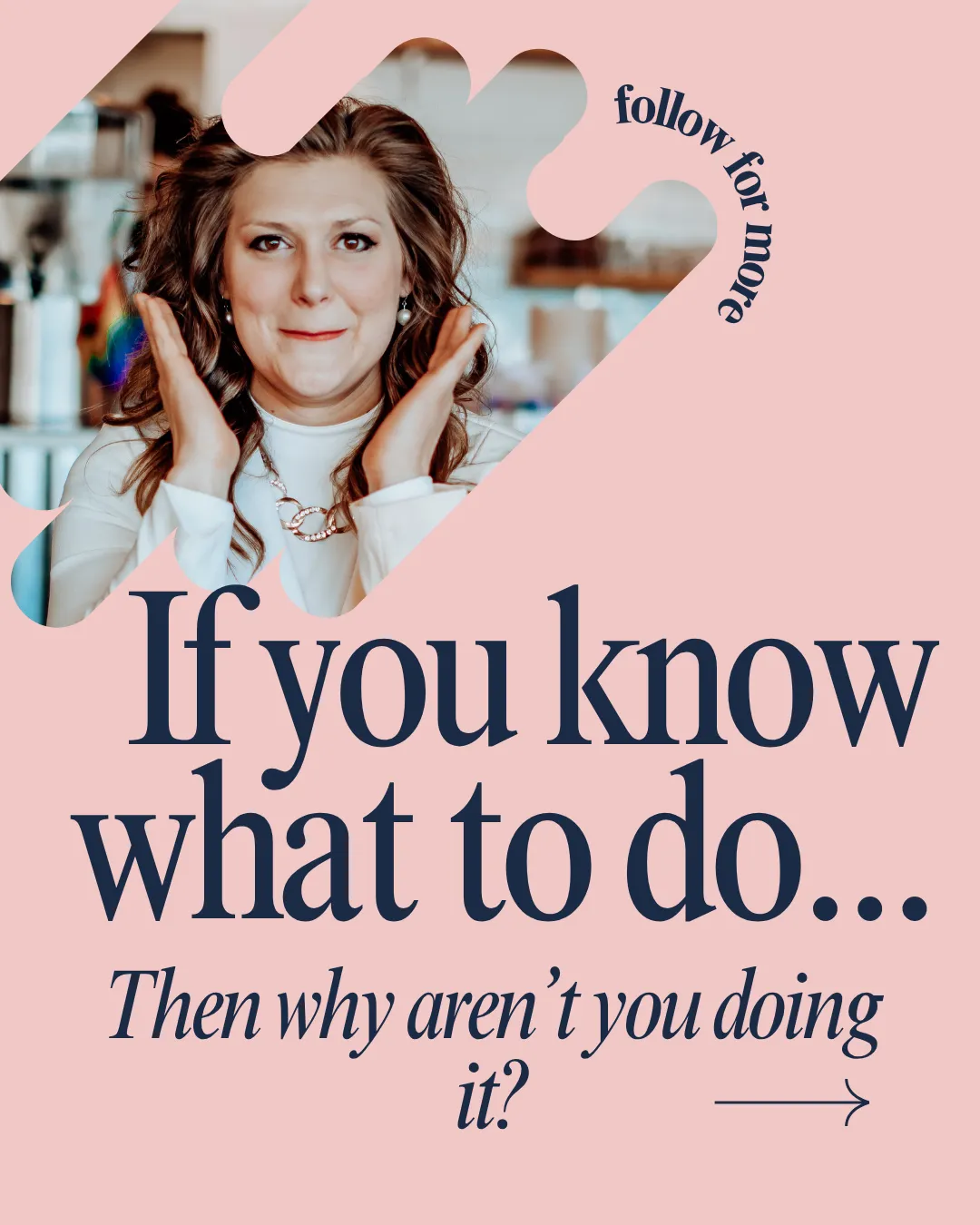
You Know What To Do...So Why Aren't You Doing It?
There’s a certain level of growth where the problem isn’t information anymore.
You’ve read the books.
You’ve built the habits.
You understand what works.
You’re not guessing.
So when something isn’t happening—
when you’re inconsistent, avoiding, or going through the motions—
it doesn’t make sense.
Because at your level…
you know better.
And that’s exactly what makes it frustrating.
It’s Not a Knowledge Gap. It’s a Self-Leadership Gap.
Most people assume the solution is:
more discipline
more structure
more accountability
But that’s not actually what’s missing.
What’s missing is your ability to lead yourself in the moment when it matters most.
Because knowing what to do happens in one state.
Doing it happens in another.
And neuroscience explains why.
Your Brain Isn’t Wired for Your Potential. It’s Wired for Familiarity.
Your brain’s primary job isn’t growth.
It’s survival.
Which means it is constantly scanning for:
what’s familiar
what’s predictable
what feels safe
Even if what’s familiar… is not what’s best.
When you go to follow through on something that stretches you—
whether that’s a conversation, a decision, or a higher standard—
your brain doesn’t evaluate it based on your goals.
It evaluates it based on certainty vs. uncertainty.
And uncertainty gets flagged as a threat.
That’s why even high-performing, disciplined people will hesitate, delay, or avoid—
not because they lack capability…
…but because their brain is trying to protect them from the unknown.
The Internal Tug-of-War You Don’t See
There’s a constant interaction happening in your brain:
The prefrontal cortex (your higher thinking, decision-making, long-term planning)
The limbic system (emotion, reward, comfort, familiarity)
When you’re clear, focused, and intentional—
your prefrontal cortex is leading.
But when something feels uncomfortable, uncertain, or emotionally charged—
that balance can shift.
And when it does, the brain will default toward:
immediate relief
familiar patterns
lower resistance choices
Even if they contradict what you know you should do.
That’s not a character flaw.
That’s biology.
Why This Shows Up Even More in High Performers
This is where it gets interesting.
Because you do have discipline.
You do follow through in many areas.
But high performers often experience a different kind of gap:
Not “I can’t do it”
but
“I don’t do it consistently in the areas that matter most.”
Why?
Because:
You’ve built systems that work in structured environments
But not always in emotional or relational ones
You execute well under clarity
But hesitate in ambiguity
And those are the exact spaces where self-leadership is required most.
The Real Problem: You’re Trying to Rely on Willpower
Most people—even high performers—still default to this:
“I just need to be more disciplined.”
But self-control isn’t just about force.
Research shows it’s influenced by:
emotional state
cognitive load
environment
and competing rewards
Which means…
If you’re relying on willpower alone,
you’re putting yourself in a position to lose.
Not because you’re weak—
but because you’re working against how your brain actually functions.
What Actually Creates Follow-Through
At this level, growth isn’t about adding more.
It’s about refining how you lead yourself.
Here’s what that looks like in practice:
1. Reduce the gap between decision and action
The longer you wait, the more your brain negotiates.
Clarity loses to comfort over time.
2. Build systems that remove friction
High performers don’t rely on motivation.
They reduce the number of decisions required.
Less thinking. More executing.
3. Train your emotional response—not just your behavior
You don’t just need better habits.
You need a better relationship with discomfort.
Because the moment something feels uncertain,
that’s when most people disengage.
4. Create alignment, not pressure
Pressure creates short-term action.
Alignment creates consistency.
And consistency is what actually compounds.
The Shift That Changes Everything
The question isn’t:
“Why am I not doing this?”
The better question is:
“What’s happening internally when I choose not to?”
Because that’s where self-leadership lives.
Not in your knowledge.
Not in your intentions.
But in your awareness of what’s happening in real time—
and your ability to lead yourself through it.
Final Thought
You’re not stuck.
You’re not lacking discipline.
You’re not missing information.
You’re just being invited to operate at a different level.
One where success isn’t built on:
knowing more
doing more
But on leading yourself better
in what you already know.
At this level, growth isn’t about what you know—it’s about how you show up in how you think, decide, and follow through.
And that’s not always something you can see clearly on your own.
There are blind spots, patterns, and defaults that are easy to navigate around…
but harder to actually shift without intention.
If you want to explore what that looks like for you—
and do that work with support—